artist bio
Autumn McLeod-Whitstone (she/they) is a Scottish-Cree artist residing in their hometown of Edmonton/Amiskwacîwâskahikan (ᐊᒥᐢᑲᐧᒋᐋᐧᐢᑲᐦᐃᑲᐣ), currently completing their BFA in Studio Arts at MacEwan University. Working with acrylics, pencil crayon, pastels and mixed media, they create non-literal self-portraits and memory-based imagery rooted in symbolism, with a recurring motif of rabbits as a proxy for their sense of self.
Their work explores their urban Indigenous identity through lived experience, alongside themes of nostalgia, mental health, trauma, feminism, and Carl Jung’s concept of the “shadow self,” bringing to light the aspects of identity we reject or are taught to hide, shaped by contemporary life and cultural memory. These internal states are externalized through the shifting personification of the rabbit, becoming an image of something soft and familiar, yet uneasy and confrontational.
Autumn confronts the idea that our younger selves are often dismissed or ignored as we get older, and invites viewers to hold space for these kids and any emotions that may surface. Viewers are given something soft and uneasy to hold in their hands and close to their heart, a younger version of themselves, a memory that has been pushed down far below, or fears they have been avoiding.
You may leave with a sense of being seen, or even exposed, and with your own rabbit lingering in the back of your mind. It watches. It observes. It follows. It lingers. What does your own rabbit look like? What does it reveal about the ways you come to understand yourself? What do you carry, and what have you left behind?
artist statement
The rabbit is an animal of survival. In light, they are innocent and intuitive; their gentleness carries the warmth of peace. Yet in shadow, they become timid and vulnerable. Exposed to fear, a prey animal is often seen as powerless, but rabbits are cunning. Paranoid little creatures that jump at every slight movement or sound, they know how to run, but their fear can also show through paralysis, retreat, and hiding.
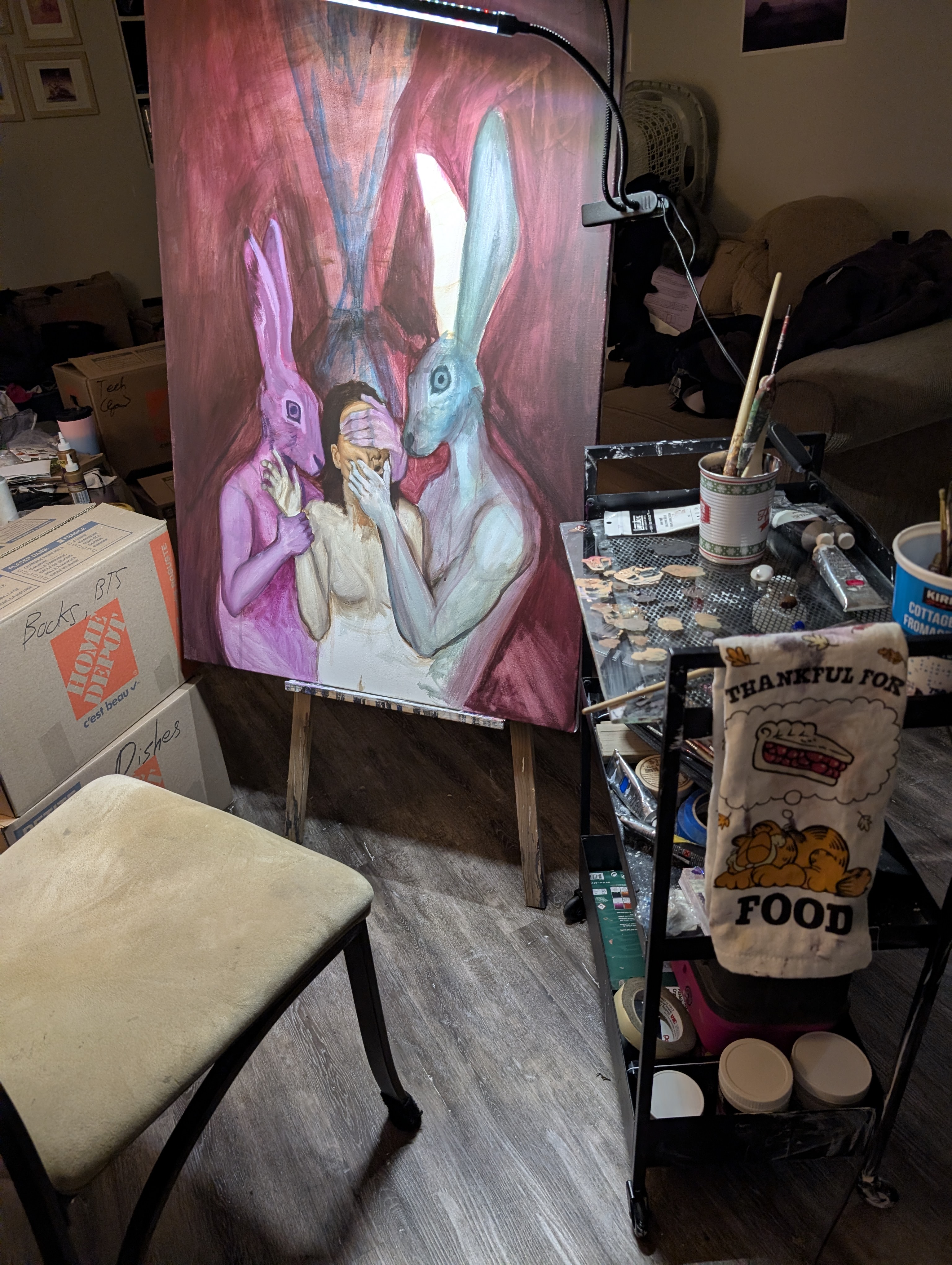
In my artistic practice, the rabbit is a proxy for my sense of self. Through symbolism and contrasting paint application, I use my work to represent the complexities of my mind and my life as a Scottish-Cree artist navigating identity within an urban environment. Heavy impasto and manic applications explore mental health, trauma, and feminine, animalistic rage, while thin, blended paint moves through memory, nostalgia, and the ache of lost innocence. The rabbit is not just an image, it is a carrier for the mind, reflecting how animals can operate within the self. As discussed by Gene Meyers, rabbits can shift between innocence and vulnerability, safety and prey status, reflecting the everchanging relationships with identity, gender, and psyche.
Drawing from Carl Jung’s concept of the shadow self , the rabbit becomes a space where opposing emotional states can coexist — fear and tenderness, instinct and repression. This idea of internalized emotions coming outward is further developed with Katrina Scott’s work exploring feminine rage.
Acting as both a mask and a mirror, the rabbit allows me to embody vulnerability outside the limits of a literal self-portrait. Aligning with some artist inspiration from Paula Rego and Beth Cavener, I use figurative and animal imagery to externalize psychological tension, vulnerability, and control.
Rabbits cannot overcome vulnerability by becoming invulnerable; instead, they survive because of their sensitivity, using it as a strength. When I cannot explain how I feel, I turn toward my rabbits. My paintings translate feeling into image, becoming a language of endurance, memory, and survival.
Citations
Marlan, Stanton. "Facing the shadow." Jungian psychoanalysis: Working in the spirit of CG Jung (2010): 5-13.
Myers, Gene. "Symbolic animals and the developing self." Anthrozoös 15.1 (2002): 19-36.
Scott, Katrina. The Nature of Feminine Rage: A Creative Exploration of Female Anger. Diss. University Honors College Middle Tennessee State University, 2021.
studio / wip